Interconnection Queue Maps
All seven US interconnection queues, mapped and re-synced every fifteen minutes — with alerts when a project withdraws and when the queue ahead of you slips.
Explore the Map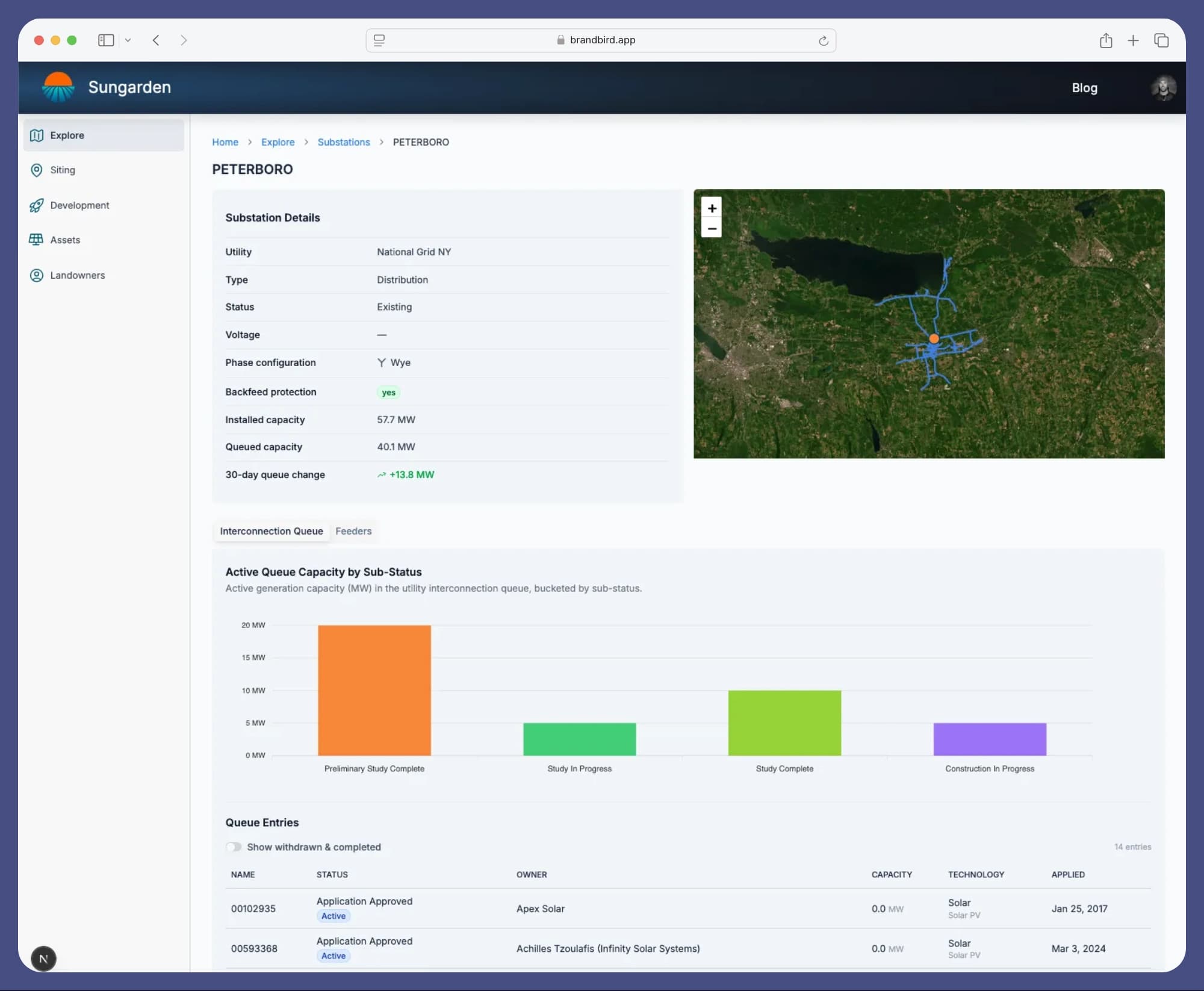
A spreadsheet is the wrong shape for this question
Every ISO publishes its interconnection queue, and every one of them publishes it as a table. That is fine for counting megawatts and useless for the question a developer actually has, which is geographic: what is queued near the site I am looking at, and at the substation I would connect to?
Sungarden syncs all seven queues and puts them on a map. The entries are placed against substations and points of interconnection, so you can see committed megawatts in the area before you spend anything on a site.
The part nobody publishes: what changed
A queue download tells you today's state. It does not tell you that the 300 MW project ahead of you pushed its in-service date out two years, or that the one next to it quietly withdrew last month. Those are the events that move your position and your cost, and they are invisible unless somebody is keeping the previous values.
We re-pull every queue on a fifteen-minute cycle and retain each snapshot. When a project's status changes or its dates move, the prior value is kept alongside the new one — and you can be alerted rather than discovering it at study time.
Markets we track
- NYISONew York StateSynced every 15 min · Parcel ownership · Hosting capacity
- PJMAll or part of 13 states from Illinois to New Jersey, plus the District of ColumbiaSynced every 15 min
- MISO15 states from the Dakotas and Minnesota south to Louisiana, plus ManitobaSynced every 15 min · Parcel ownership
- CAISOMost of CaliforniaSynced every 15 min
- ERCOTRoughly 90% of Texas load, on an electrically islanded gridSynced every 15 min
- ISO-NEConnecticut, Maine, Massachusetts, New Hampshire, Rhode Island and VermontSynced every 15 min
- SPP14 states across the central US, from the Dakotas to TexasSynced every 15 min
Where queue data meets land data
Queue coverage is national. Parcel ownership and utility hosting capacity are not — today those are New York and, for parcels, Minnesota. So in NYISO territory you can go from a queue entry to the feeder to the name on the deed without leaving the map, and in most other markets you get the queue intelligence without the land layer underneath it.
We would rather say that plainly than imply coverage we don't have. If you develop somewhere the land layer matters and we don't have it, tell us where — that is genuinely how we decide what to buy next. New York developers should start from the hosting capacity maps.
Frequently asked questions
What is an interconnection queue?
Every grid operator maintains a queue of generation and storage projects that have applied to connect. Each entry carries a requested capacity, a point of interconnection, a proposed in-service date, and a status. The queue is the single best public record of what other developers are trying to build and where.
How often does Sungarden re-sync the queues?
Every fifteen minutes, for all seven ISOs. We keep every snapshot, so rather than only the current state you get each project's history: when its status changed, when its dates moved, and when it withdrew.
Why does queue position matter so much?
Because interconnection cost is largely determined by who is ahead of you. Projects queued earlier are studied first, and upgrades triggered by their capacity can be assigned to them — or, if they withdraw, reassigned to you. A project that looked expensive can become cheap when a large project ahead of it drops out, which is exactly the event most developers find out about too late.
Is queued capacity the same as capacity that will get built?
No, and the gap is large. Historically only a minority of queued capacity reaches commercial operation — withdrawal rates across US markets are high. Queued megawatts are also not deliverable megawatts: several markets allocate deliverability separately from queue position, so a project can hold a position without being able to deliver energy. Read aggregate queue totals as a measure of intent, not supply.
What is schedule slip, and why track it?
Projects routinely move their proposed in-service and commercial operation dates. Sungarden keeps the previous value alongside the new one every time a date changes, so you can see which projects ahead of you are slipping. If the queue in front of you is sliding, your effective position is improving — and that is not visible in any single snapshot of the queue.
See what's queued before you commit.
Get Started For FreeSungarden is an independent platform and is not affiliated with or endorsed by any ISO or RTO.
Queue data is republished from each ISO'sown public interconnection queue postings. We do not independently verify it, and where our records differ from the ISO's published queue the ISO's data governs. Queue entries reflect what a developer reported at the time of filing: capacity figures, in-service dates, and points of interconnection all change, and a project appearing in the queue is not evidence that it will be built.
Queued capacity is not deliverable capacity. Several markets allocate deliverability separately from queue position, so a project can hold a queue position without being able to deliver energy, and aggregate queued megawatts should not be read as committed supply.
Descriptions of interconnection processes on this page are general summaries. Interconnection rules are being revised across every market under FERC Order 2023 and its compliance filings, so procedures, timelines and study structures change. Nothing here is legal or engineering advice or a substitute for the ISO's current tariff and business practice manuals — confirm applicable requirements with the ISO.