New York Hosting Capacity Maps
All six Joint Utilities on one map — with statewide parcel ownership and the live SIR interconnection queue beside them.
Explore the Map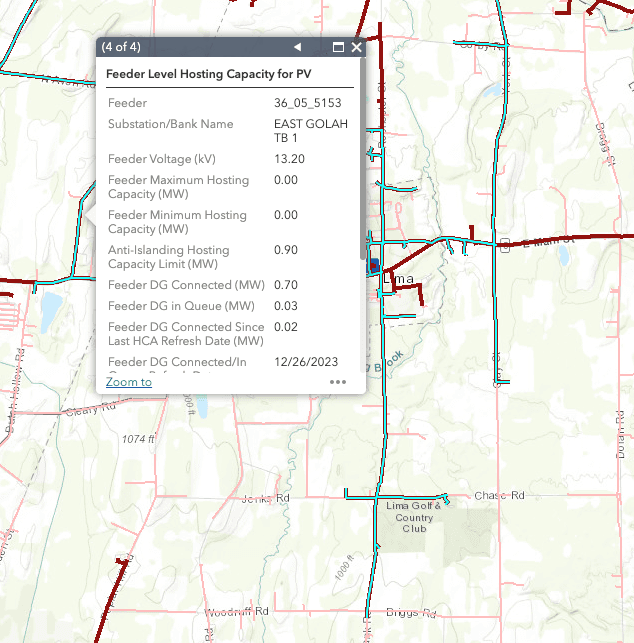
Six utilities, six portals, one map
New York is the best-documented distributed generation market in the country. Under the state's Reforming the Energy Vision proceedings, all six investor-owned utilities publish feeder-level hosting capacity — a genuine advantage for developers, and a genuinely tedious one to use. Each utility built its own viewer, with its own symbology, refresh cadence, and attribute names. NYSEG and RG&E share one between them. None include parcels, ownership, or the interconnection queue.
Screening a region therefore means opening five or six portals, reading each one differently, and then cross-referencing the result against county parcel viewers and a queue spreadsheet by hand. Sungarden normalizes all six onto a single map and puts parcels, ownership, substations, and the live SIR queue on top of them.
New York hosting capacity by utility
- National GridUpstate New York, from Albany west to BuffaloFeeder hosting capacity · Parcel ownership · Live queue
- Con EdisonNew York City and Westchester CountyFeeder hosting capacity · Parcel ownership · Live queue
- NYSEGNon-contiguous territory across roughly 40% of upstate New YorkFeeder hosting capacity · Parcel ownership · Live queue
- RG&ERochester and the nine surrounding countiesFeeder hosting capacity · Parcel ownership · Live queue
- Central HudsonThe Mid-Hudson Valley, from Poughkeepsie to CatskillFeeder hosting capacity · Parcel ownership · Live queue
- Orange & RocklandOrange, Rockland, and Sullivan countiesFeeder hosting capacity · Parcel ownership · Live queue
The territories behave nothing like each other
A statewide search is really six different searches. In Con Edison territory, secondary networks make much of New York City close to unbuildable and land is the scarce input. Across NYSEG and National Grid territory land is abundant and a circuit with headroom is the prize. In Orange & Rockland the system is small enough that queue position decides outcomes, and in Central Hudson terrain and land use disqualify sites the capacity map calls fine.
Frequently asked questions
Who are the Joint Utilities of New York?
The six investor-owned electric utilities that serve New York: National Grid, Con Edison, NYSEG, RG&E, Central Hudson, and Orange & Rockland. Under the state's Reforming the Energy Vision proceedings they committed to publishing distribution system data, including feeder-level hosting capacity, through public portals. Each publishes separately, in its own format, on its own schedule.
What is the SIR process?
New York's Standardized Interconnection Requirements govern distributed generation projects up to 5 MW. Projects above that threshold go through NYISO's interconnection process instead. The SIR sets the application steps, timelines, and study requirements that apply uniformly across all six utilities, even though each utility administers its own queue.
What is a CESIR and how does hosting capacity relate to it?
A Coordinated Electric System Interconnection Review is the utility study that determines what your interconnection will actually cost. Hosting capacity is a screening tool that comes before it — a published estimate of how much generation a circuit can take before significant upgrades are needed. Screening on capacity and queue position together is the cheapest way to avoid paying for a CESIR that comes back with a seven-figure upgrade bill.
Why do I need six different portals?
Because each utility built its own. The data is broadly comparable but the viewers are not: different symbology, different refresh cadence, different attribute names, and in NYSEG and RG&E's case a single shared viewer covering two territories. None of them include parcels, ownership, or the interconnection queue. Sungarden normalizes all six onto one map.
Does New York parcel data come with ownership information?
Yes. Sungarden carries statewide New York parcel boundaries with ownership attributes, which is what makes capacity data actionable — you can move from a feeder with headroom to the name on the deed without leaving the map.
Screen all of New York at once.
Get Started For FreeFree during beta
Sungarden is an independent platform and is not affiliated with or endorsed by any New York utility. Hosting capacity and system data are sourced from each utility's published datasets and are intended for screening only.