ISO-NE Interconnection Queue Map
New England's interconnection queue on a map, re-synced every fifteen minutes — with Central Maine Power and Versant feeder and substation data alongside it.
Explore the Map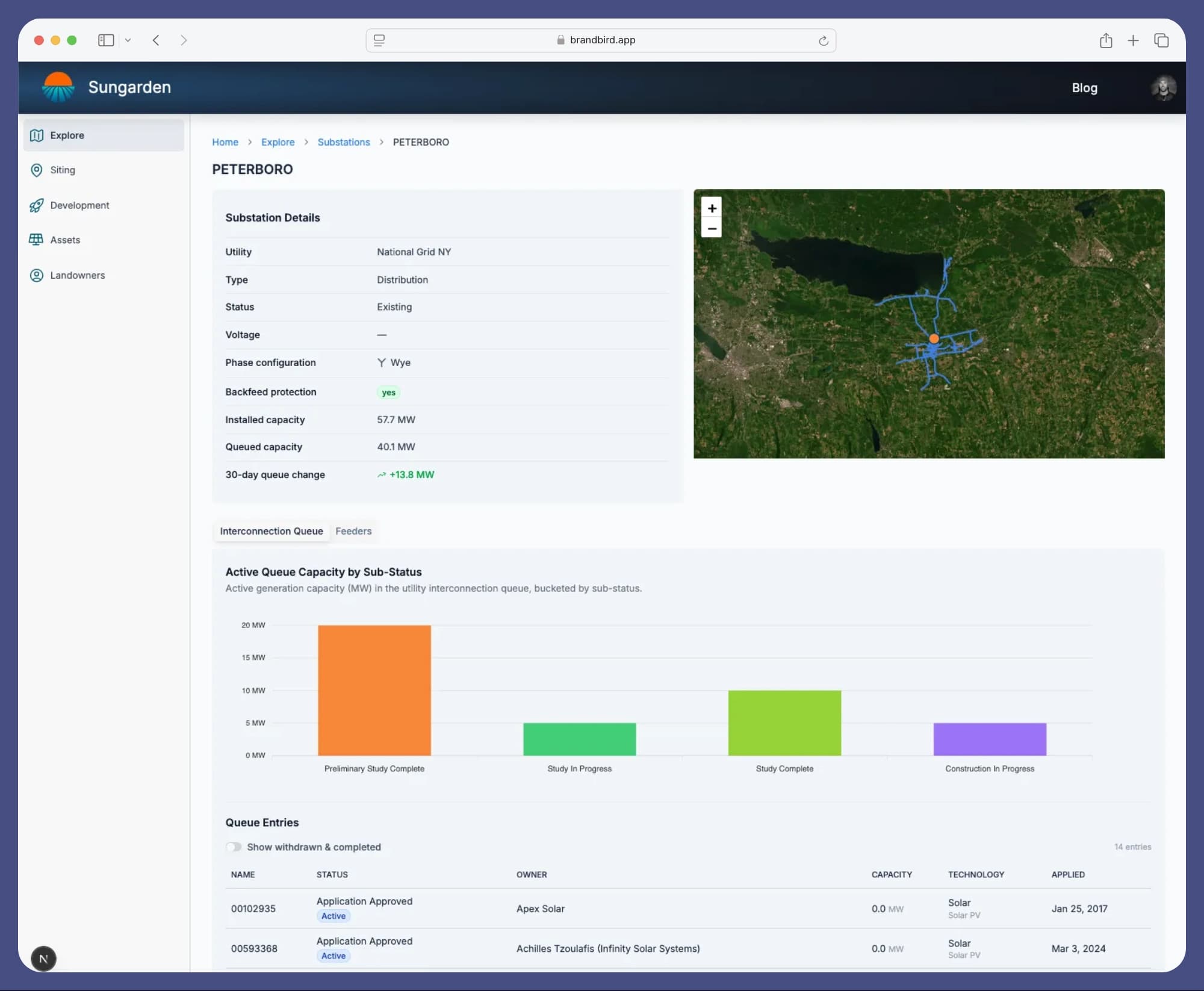
A small, tightly constrained footprint
ISO New England covers six states, and it is the most transmission-constrained of the US markets relative to its size. Northern New England in particular has limited capability to move power south toward the load centres, which is why generation sited north of those constraints faces a very different economic picture from generation sited near them.
That makes location within the footprint unusually decisive. In a large market a project can often be moved a county over without materially changing its interconnection story. In New England, where a site sits relative to the constrained interfaces is frequently the whole question.
Where we go below the transmission layer
Maine is the part of this footprint where our data goes deeper than the ISO queue. We carry Central Maine Power feeder hosting capacity, and feeder and substation data for both CMP and Versant, so a Maine project can be screened against the distribution system as well as the transmission queue.
We do not yet carry Maine parcel boundaries, so the land layer is missing there — worth stating plainly rather than leaving you to discover it. Across the rest of New England you get the queue, the status and date history, and alerts when projects withdraw or slip.
What Sungarden loads for ISO-NE
- Queue entries, re-synced every 15 minutes
- Schedule-slip tracking — we keep the previous and new withdrawal, completion and commercial-operation dates
- Alerts when a project's status changes or it withdraws
- Daily queued-capacity history by status and fuel type
- Not loaded yet: Points of interconnection as mapped geometry
- Not loaded yet: Load and pricing zone boundaries
- Not loaded yet: Substations
- Not loaded yet: Parcel boundaries and ownership within the footprint
- Not loaded yet: Utility feeder hosting capacity within the footprint
Queue entries are the ISO's own records, republished rather than recalculated. Capacity figures are what the developer reported at filing, and queued megawatts are not deliverable megawatts — several markets allocate deliverability separately from queue position.
Frequently asked questions
How does the ISO-NE interconnection process work?
ISO New England studies interconnection requests through a staged process that has moved toward cluster-based evaluation, in which grouped projects are studied together and identified upgrades allocated among them. Procedures across every US market are being revised under FERC Order 2023 compliance, so confirm current requirements and cluster timing with ISO-NE.
Why does transmission constraint matter more here?
Because the footprint is small and the internal interfaces bind. Northern New England has limited capability to export south toward the load centres, so generation added behind those constraints competes for the same limited transfer capability. Location relative to the constrained interfaces often determines a project's economics more than its interconnection cost does.
What Maine data do you carry beyond the ISO queue?
Central Maine Power feeder hosting capacity, plus feeder and substation data for both CMP and Versant Power. That means a Maine site can be screened against distribution-level capacity as well as the transmission queue — which is unusual for a market outside New York in our coverage.
Do you carry New England parcel data?
Not yet. Parcel boundaries and ownership are limited to New York and Minnesota, so in ISO-NE territory — including Maine, where our grid data is otherwise deeper — there is no ownership layer. If that is the gap that matters for your work, tell us.
How current is the queue data?
We re-pull the ISO-NE queue every fifteen minutes and keep every snapshot, so you get each project's status and date history rather than only its present state, with alerts when a project withdraws or moves its dates.
Other interconnection queues
Or start from the interconnection queue overview to compare every market we track.
Screen New England against the queue and the distribution system.
Get Started For FreeSungarden is an independent platform and is not affiliated with or endorsed by ISO-NE (ISO New England).
Queue data is republished from ISO-NE'sown public interconnection queue postings. We do not independently verify it, and where our records differ from the ISO's published queue the ISO's data governs. Queue entries reflect what a developer reported at the time of filing: capacity figures, in-service dates, and points of interconnection all change, and a project appearing in the queue is not evidence that it will be built.
Queued capacity is not deliverable capacity. Several markets allocate deliverability separately from queue position, so a project can hold a queue position without being able to deliver energy, and aggregate queued megawatts should not be read as committed supply.
Descriptions of interconnection processes on this page are general summaries. Interconnection rules are being revised across every market under FERC Order 2023 and its compliance filings, so procedures, timelines and study structures change. Nothing here is legal or engineering advice or a substitute for the ISO's current tariff and business practice manuals — confirm applicable requirements with the ISO.