NYISO Interconnection Queue Map
New York's transmission-level queue on a map — beside statewide parcel ownership, Joint Utility hosting capacity, and load zone boundaries.
Explore the Map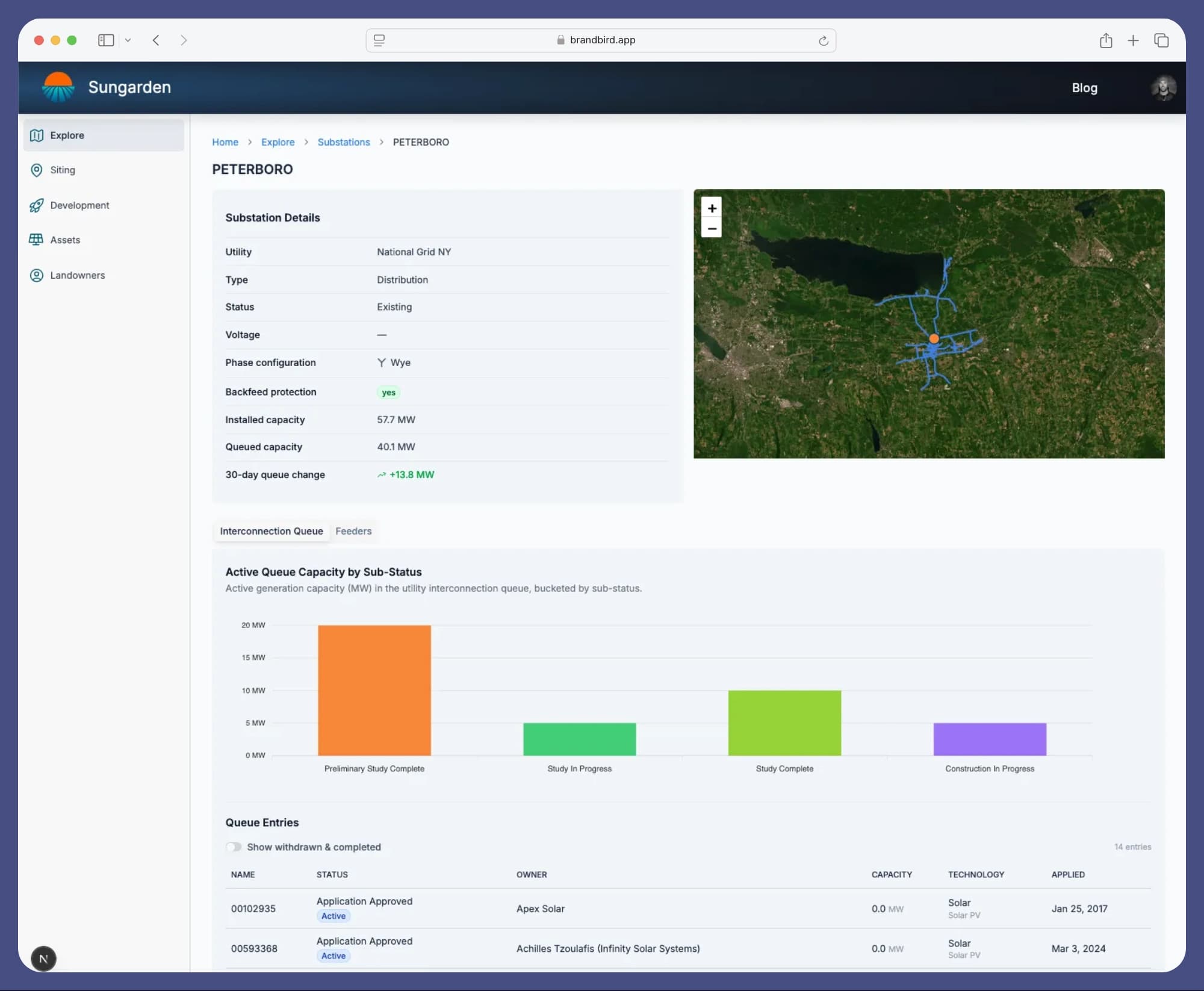
The one market where the whole stack lines up
New York is where our coverage is deepest, and it is worth being specific about why that matters. In most markets a queue map tells you what other developers are chasing. Here it sits on top of statewide parcel boundaries with ownership, and feeder-level hosting capacity for all six Joint Utilities — so a single view answers what is queued nearby, whether the distribution system has room, and who owns the ground.
That also means the two queues matter together. Distribution-scale projects run through the state's SIR process; transmission-level and larger projects run through NYISO. A developer working a 20 MW site and a developer working a 4 MW community solar project are reading different queues about the same piece of land.
Class Year means your neighbours set your price
NYISO evaluates interconnection requests in groups. Projects that reach the relevant stage are placed into a Class Year and studied together, with the upgrades that group triggers allocated among its members. So your interconnection cost is not a property of your project — it is a property of your cohort.
Which makes withdrawals and slippage the events that matter most. When a large project in your Class Year drops out, the allocation shifts. We keep every fifteen-minute snapshot of the queue, so a status change or a date movement is recorded with its previous value rather than silently overwritten — and you can be alerted instead of hearing about it at study time.
What Sungarden loads for NYISO
- Queue entries, re-synced every 15 minutes
- Schedule-slip tracking — we keep the previous and new withdrawal, completion and commercial-operation dates
- Alerts when a project's status changes or it withdraws
- Daily queued-capacity history by status and fuel type
- Load and pricing zone boundaries
- Parcel boundaries and ownership within the footprint
- Utility feeder hosting capacity within the footprint
- Not loaded yet: Points of interconnection as mapped geometry
- Not loaded yet: Substations
Queue entries are the ISO's own records, republished rather than recalculated. Capacity figures are what the developer reported at filing, and queued megawatts are not deliverable megawatts — several markets allocate deliverability separately from queue position.
Frequently asked questions
What is the NYISO Class Year process?
NYISO studies interconnection requests in groups rather than one at a time. Projects that have completed the earlier study stages are placed into a Class Year and evaluated together, and the system upgrades that group triggers are allocated among its members. The consequence for a developer is that your cost is not set by your project alone — it depends on who else is in your Class Year and whether they stay in. Interconnection procedures across all US markets are being revised under FERC Order 2023, so confirm the current process with NYISO.
When does a project go to NYISO rather than through the SIR?
New York's Standardized Interconnection Requirements cover distribution-connected generation and storage of 5 MW AC or less. Larger distribution-connected projects go through the utility's own process, and projects interconnecting to the bulk transmission system go through NYISO's procedures. Size alone does not determine it — what governs is the system you connect to. Confirm with the utility and NYISO before relying on either path.
What are NYISO load zones and why do they matter?
New York is divided into eleven load zones, labelled A through K, running roughly west to east. They matter commercially because energy and capacity prices differ by zone: the downstate zones, particularly Zone J covering New York City and Zone K covering Long Island, have historically cleared well above the upstate zones. Sungarden carries the zone boundaries, so you can see which zone a site sits in alongside what is queued near it.
Can I see New York parcels and hosting capacity here too?
Yes — NYISO is the market where our coverage is deepest. Statewide New York parcel boundaries with owner attributes, feeder-level hosting capacity for the Joint Utilities, and substation-level queue data are all on the same map. You can move from a queue entry to the circuit to the name on the deed without switching tools.
How current is the queue data?
We re-pull the NYISO queue every fifteen minutes and keep every snapshot, so you get each project's status and date history rather than just its current state — including alerts when a project withdraws or pushes its dates out.
Other interconnection queues
Or start from the interconnection queue overview to compare every market we track.
Read the queue and the land together.
Get Started For FreeSungarden is an independent platform and is not affiliated with or endorsed by NYISO (New York Independent System Operator).
Queue data is republished from NYISO'sown public interconnection queue postings. We do not independently verify it, and where our records differ from the ISO's published queue the ISO's data governs. Queue entries reflect what a developer reported at the time of filing: capacity figures, in-service dates, and points of interconnection all change, and a project appearing in the queue is not evidence that it will be built.
Queued capacity is not deliverable capacity. Several markets allocate deliverability separately from queue position, so a project can hold a queue position without being able to deliver energy, and aggregate queued megawatts should not be read as committed supply.
Descriptions of interconnection processes on this page are general summaries. Interconnection rules are being revised across every market under FERC Order 2023 and its compliance filings, so procedures, timelines and study structures change. Nothing here is legal or engineering advice or a substitute for the ISO's current tariff and business practice manuals — confirm applicable requirements with the ISO.