Utility Hosting Capacity Maps
Feeder-level hosting capacity from every utility we cover — on the same map as parcel ownership, substations, and live interconnection queue data.
Explore the Map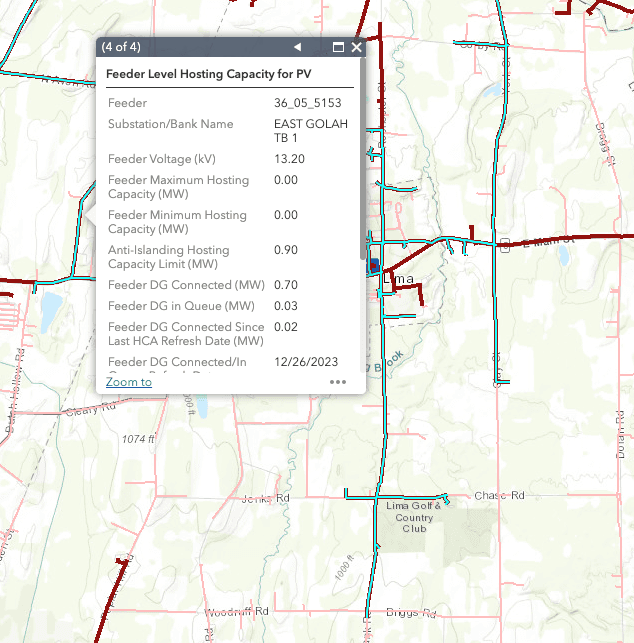
Good data, trapped in the wrong tool
Utility hosting capacity maps are the single most useful public dataset in distributed solar development. They tell you, circuit by circuit, roughly how much generation the distribution system can absorb before upgrades get expensive — which is the question that decides whether a site is worth pursuing.
They are also published one utility at a time, in standalone GIS viewers that contain nothing else. No parcel boundaries. No ownership. No interconnection queue. No wetlands, slope, or protected areas. Screening a region means opening a portal per utility, then cross-referencing county parcel viewers and queue spreadsheets by hand — which is why most developers do it once and then stop.
Sungarden syncs each utility's published data and puts it on one map with everything the portals leave out. Read more about how the underlying data works in our guide to utility hosting capacity maps.
New York hosting capacity maps
New York runs distributed generation interconnection through Standardized Interconnection Requirements, with per-project costs set by the utility's CESIR study. We cover 6 utilities in New York.
- National GridUpstate New York, from Albany west to BuffaloFeeder hosting capacity · Parcel ownership · Live queue
- Con EdisonNew York City and Westchester CountyFeeder hosting capacity · Parcel ownership · Live queue
- NYSEGNon-contiguous territory across roughly 40% of upstate New YorkFeeder hosting capacity · Parcel ownership · Live queue
- RG&ERochester and the nine surrounding countiesFeeder hosting capacity · Parcel ownership · Live queue
- Central HudsonThe Mid-Hudson Valley, from Poughkeepsie to CatskillFeeder hosting capacity · Parcel ownership · Live queue
- Orange & RocklandOrange, Rockland, and Sullivan countiesFeeder hosting capacity · Parcel ownership · Live queue
Coverage we're working on
Maine is next — Central Maine Power and Versant feeder and substation data are already loaded, with landing pages to follow. Interconnection queue coverage is already national: NYISO, PJM, MISO, CAISO, ERCOT, ISO-NE, and SPP queues are all synced and mapped to substations, even in territories where we don't yet carry hosting capacity.
Developing somewhere we don't cover yet? Tell us where — coverage requests genuinely drive what we build next.
Frequently asked questions
What is a hosting capacity map?
A hosting capacity map shows how much distributed generation — typically solar — each distribution feeder can accommodate without triggering significant system upgrades. Utilities publish it at the feeder level, usually as a minimum and maximum range, so developers can screen locations before filing an interconnection application.
Why do utilities publish hosting capacity at all?
Mostly because regulators required it. New York's Reforming the Energy Vision proceedings and comparable dockets in other states pushed utilities to publish distribution system data so that developers could self-screen instead of filing speculative applications that clog the queue and burn utility study resources.
What do minimum and maximum hosting capacity mean?
Capacity varies along the length of a feeder, so utilities report a range. It is typically highest near the substation and declines toward the end of the line as voltage rise and thermal limits bind. A parcel near the feeder backbone may see close to the maximum; one at the edge may not reach the minimum.
Does hosting capacity tell me what interconnection will cost?
No. It is a screening tool. Actual costs come from the utility's impact study — a CESIR in New York. But screening capacity and queue position together dramatically improves your odds: a feeder with headroom and nothing queued ahead of you is far less likely to return a seven-figure upgrade estimate.
Why isn't the utility's own portal enough?
Because a capacity value on its own isn't actionable. The portals are standalone GIS viewers with no parcel boundaries, no ownership information, and no link to the interconnection queue. You can see that a feeder has headroom, but not who owns the land under it, whether the ground is buildable, or how many projects are already queued at the substation it feeds.
Start from capacity, not from hope.
Get Started For FreeFree during beta
Sungarden is an independent platform and is not affiliated with or endorsed by any utility. Hosting capacity and system data are sourced from each utility's published datasets and are intended for screening only.