NYSEG Hosting Capacity Map
Feeder hosting capacity across NYSEG's upstate territory — on the same map as parcels, ownership, substations, and the live SIR interconnection queue.
Explore the Map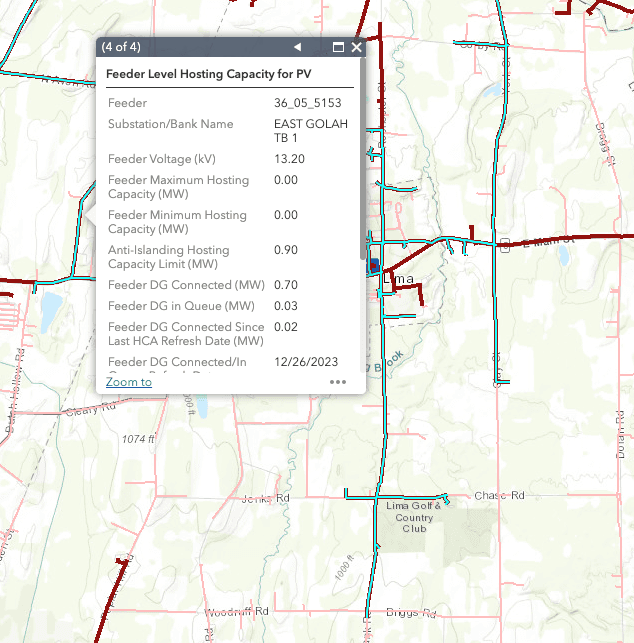
A patchwork territory, and why that matters
NYSEG covers more of upstate New York than any other utility — close to 40% of the state's land area — but it does so in non-contiguous pockets interleaved with National Grid, RG&E, and municipal systems. Two farms on opposite sides of the same road can sit in different service territories, which means different portals, different queues, and an entirely different capacity picture.
NYSEG also shares its hosting capacity viewer with RG&E, both being Avangrid companies. Convenient in principle, and a quiet source of error in practice: it is genuinely easy to read a circuit, note the capacity, and not register which of the two utilities you would actually be filing with.
Long rural feeders make position on the line decisive
Rural territory means long radial circuits. Hosting capacity is highest near the substation and tapers along the line as voltage rise and thermal limits take hold, so utilities publish it as a range. On NYSEG's longest feeders that range is wide enough that the reported minimum and maximum describe two different projects — one financeable, one not.
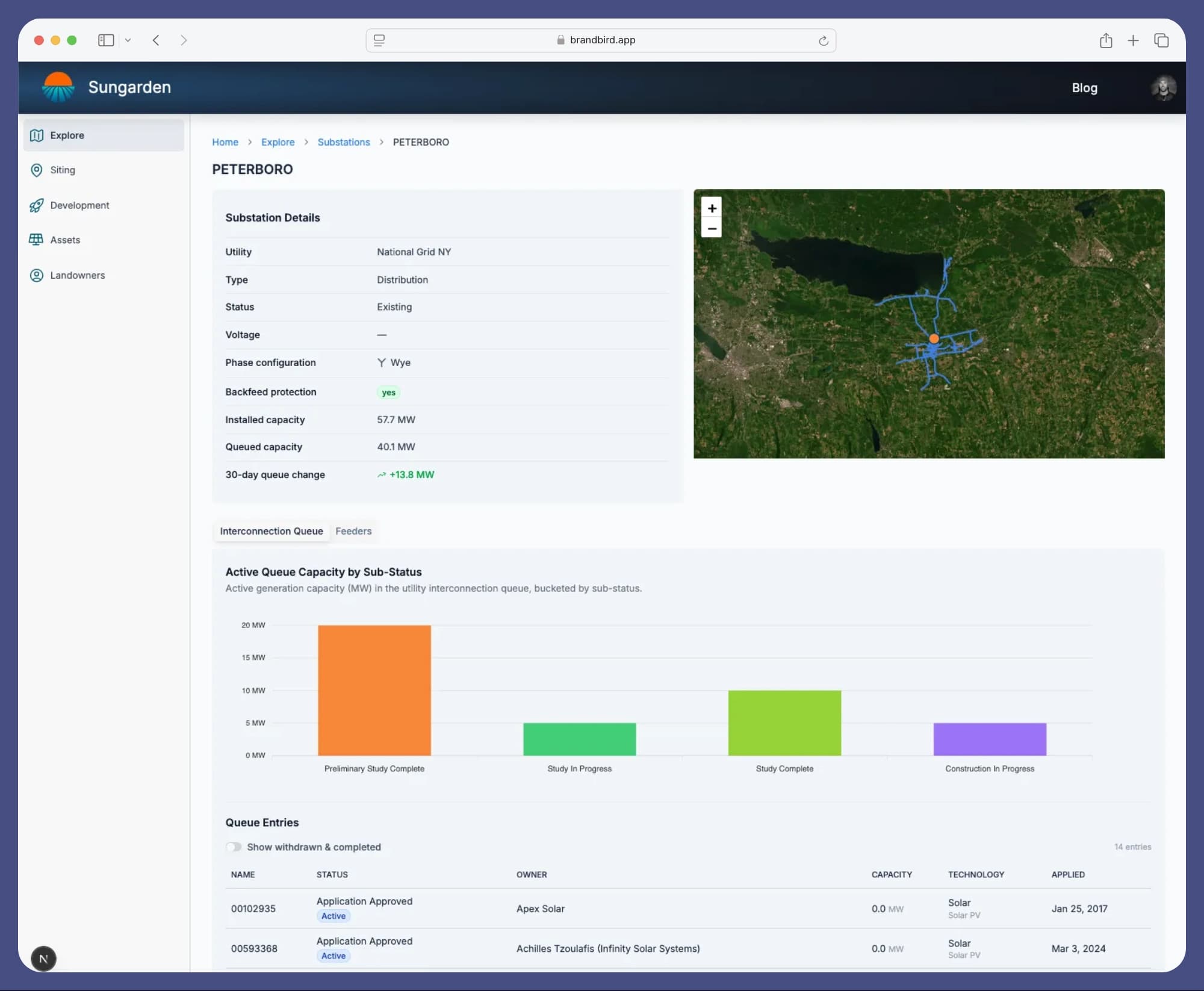
Land is the easy part of this territory; a circuit with headroom is the hard part. Sungarden keeps NYSEG's hosting capacity map in sync and layers it with parcel boundaries and ownership, substations, and New York's SIR queue, so you can filter for feeders above your project size and then see who owns the ground near the strong end of the line.
What Sungarden loads for NYSEG
- Feeder-level hosting capacity
- Feeder geometry and attributes
- Substations
- Parcel boundaries and ownership (New York)
- Interconnection queue, mapped to substations
Not yet loaded for this territory: feeder load curves.
Frequently asked questions
Where does NYSEG publish its hosting capacity map?
NYSEG publishes feeder-level hosting capacity through the Avangrid distributed generation portal it shares with RG&E, as part of the Joint Utilities of New York's commitments under the state's Reforming the Energy Vision proceedings. One viewer covers both utilities, so it is easy to read a circuit without noticing which company's territory you are actually in.
Why does capacity fall off so sharply on NYSEG circuits?
NYSEG's territory is largely rural, which means long radial feeders running far from their substations. Hosting capacity is highest near the substation and declines along the line as voltage rise and thermal limits bind. On a long rural circuit the difference between the reported minimum and maximum can be the difference between a viable project and an unbuildable one, and where your parcel sits along that line decides which number applies to you.
Why is NYSEG territory so fragmented?
NYSEG serves a non-contiguous patchwork covering roughly 40% of upstate New York's land area, interleaved with National Grid, RG&E, and municipal systems. Two parcels a few miles apart can sit in different service territories, with different portals, different queues, and different capacity pictures. Screening by geography alone will mislead you here.
Is land or grid capacity the constraint in NYSEG territory?
Grid capacity, nearly always. Unlike Con Edison territory, buildable agricultural land is abundant and comparatively affordable across NYSEG's footprint. The scarce resource is a circuit with headroom, which is why the workflow is to filter for feeders that can take your project size and then work outward to the parcels around them.
How current is the data in Sungarden?
Sungarden syncs NYSEG's published hosting capacity and substation data on a regular schedule, and monitors New York's SIR queue continuously — including alerts when projects withdraw and capacity frees up at a substation.
Other New York hosting capacity maps
Or start from the New York hosting capacity overview to compare every utility in the state on one map.
Find your next site on NYSEG's system.
Get Started For FreeFree during beta
Sungarden is an independent platform and is not affiliated with or endorsed by NYSEG. Hosting capacity and system data are sourced from NYSEG's published datasets and are intended for screening only — not as a substitute for a utility interconnection study.