RG&E Hosting Capacity Map
Feeder hosting capacity for Rochester Gas and Electric's territory — on the same map as parcels, ownership, substations, and the live SIR interconnection queue.
Explore the Map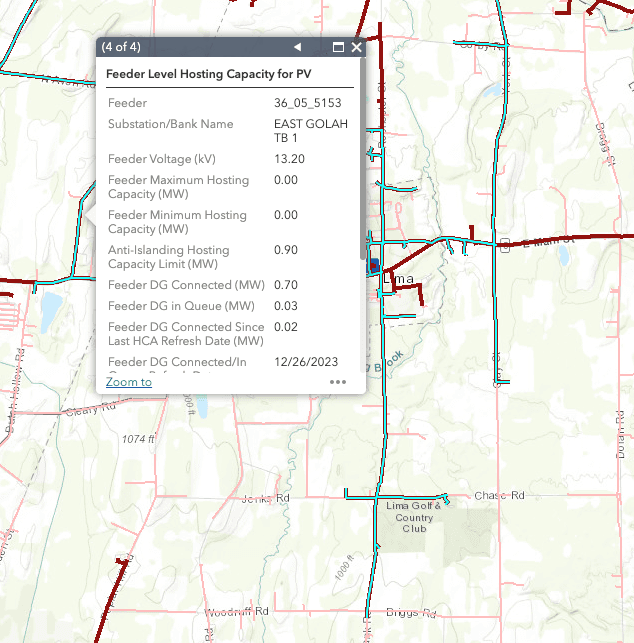
A compact system with a narrow sweet spot
RG&E serves Rochester and nine surrounding counties — a small, dense territory compared with its Avangrid sibling NYSEG. Shorter feeders and more substations per square mile mean hosting capacity is distributed more evenly, and position along a circuit is less often the thing that kills a project.
The constraint moves to land instead. Circuits with real headroom tend to sit in built-up suburban areas where parcels are small and expensive, while the large affordable parcels sit further out where capacity starts thinning. The workable band is the agricultural ring just past the suburbs — narrow enough that screening capacity and parcel size at the same time beats doing them in sequence.
One portal, two utilities, two different filings
Because RG&E and NYSEG share a hosting capacity viewer, it is easy to read a promising circuit and not register which company you would actually be filing with. The capacity number is only half the information; the territory determines the queue you enter and the counterparty you negotiate with.
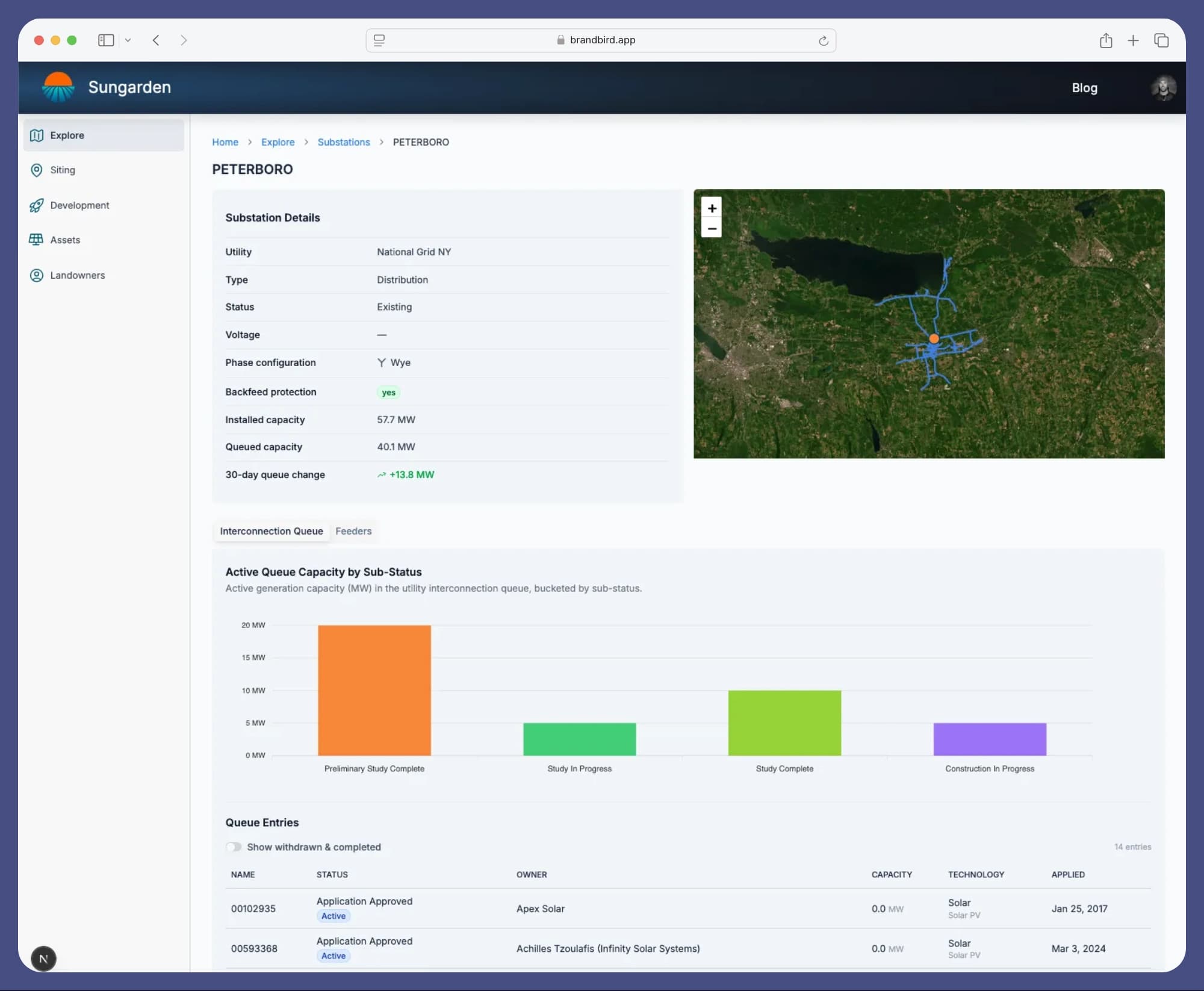
Sungarden keeps RG&E's hosting capacity map in sync and attributes every feeder to its utility, then layers it with parcel boundaries and ownership, substations, and New York's SIR queue — so the territory question answers itself while you are still screening.
What Sungarden loads for RG&E
- Feeder-level hosting capacity
- Feeder geometry and attributes
- Substations
- Parcel boundaries and ownership (New York)
- Interconnection queue, mapped to substations
Not yet loaded for this territory: feeder load curves.
Frequently asked questions
Where does RG&E publish its hosting capacity map?
RG&E publishes feeder-level hosting capacity through the Avangrid distributed generation portal it shares with NYSEG, under the Joint Utilities of New York's commitments from the state's Reforming the Energy Vision proceedings. Because one viewer serves both utilities, confirm which territory a circuit belongs to before you build a pro forma around it.
How does RG&E territory differ from NYSEG's?
RG&E's territory is compact and centered on Rochester, covering the city and nine surrounding counties. Circuits are shorter and substations are denser than on NYSEG's rural system, so capacity tends to be more evenly distributed and less punishing about where along a feeder you sit. The tradeoff is land: parcels close to the strongest circuits are suburban, smaller, and more expensive.
Where are the best siting opportunities in RG&E territory?
Typically the agricultural ring outside the Rochester suburbs, where parcels are still large and affordable but circuits have not yet run the long distances that erode capacity upstate. That band is narrow, which is why screening capacity and parcel size together — rather than sequentially — matters more here than in a territory with land to spare.
Does hosting capacity tell me what interconnection will cost?
No. Hosting capacity is a screening tool; actual costs come out of the utility's Coordinated Electric System Interconnection Review, the CESIR. But screening hosting capacity and queue position together materially improves your odds. A circuit with headroom and nothing queued ahead of you is far less likely to return a seven-figure upgrade estimate.
How current is the data in Sungarden?
Sungarden syncs RG&E's published hosting capacity and substation data on a regular schedule, and monitors New York's SIR queue continuously — including alerts when projects withdraw and capacity frees up at a substation.
Other New York hosting capacity maps
Or start from the New York hosting capacity overview to compare every utility in the state on one map.
Find your next site on RG&E's system.
Get Started For FreeFree during beta
Sungarden is an independent platform and is not affiliated with or endorsed by RG&E. Hosting capacity and system data are sourced from RG&E's published datasets and are intended for screening only — not as a substitute for a utility interconnection study.